
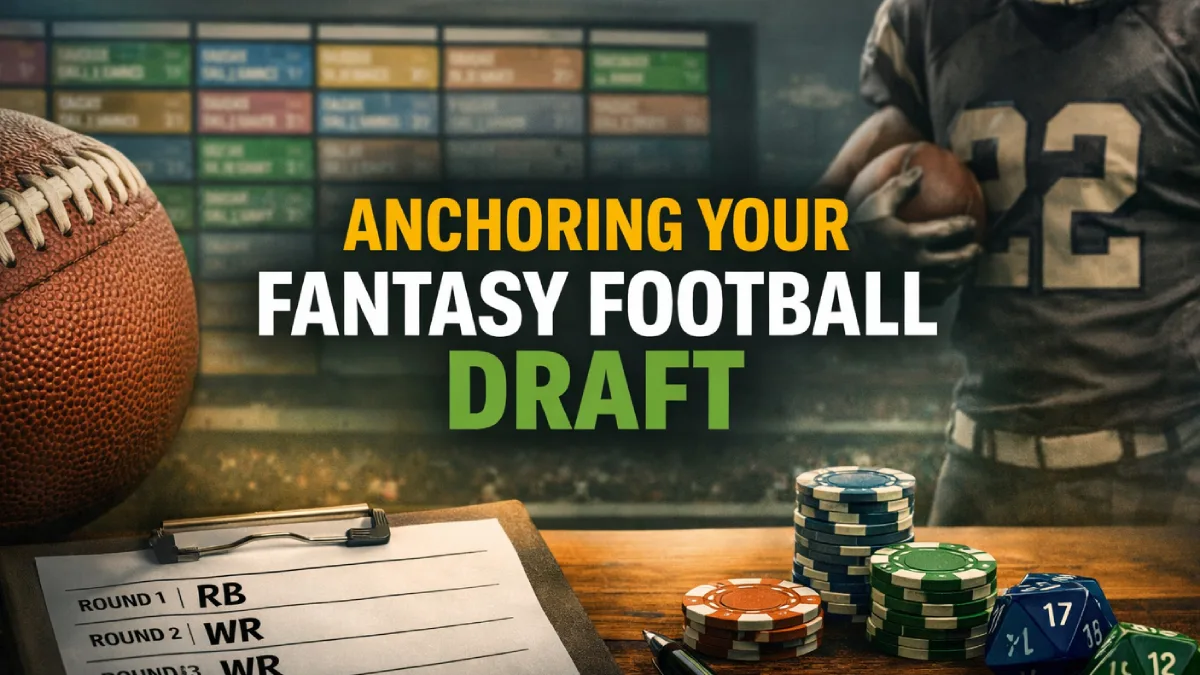
Your fantasy football draft isn’t just about picking good players—it’s about building a roster structure.
And that structure is often decided in your first one or two picks.
That’s where anchoring comes in.
Anchoring is one of the most important (and overlooked) concepts in fantasy football draft strategy. It quietly shapes every decision you make—from Round 2 all the way to your final pick.
What Is Anchoring in Fantasy Football?
Anchoring is the strategy of drafting a foundational player early—typically at a scarce or high-impact position—and building the rest of your roster around them.
Think of your anchor as:
- Your team’s weekly production baseline
- A positional safety net
- The piece that dictates your draft flow
Common Anchor Types
- RB Anchor (most common): Locks in volume and scarcity
- WR Anchor: Secures elite consistency and target share
Why Anchoring Matters
Anchoring isn’t just a buzzword—it directly impacts how your draft unfolds.
1. Positional Scarcity
- Running backs are limited and fragile
- Wide receivers are deeper and easier to replace
📝 Anchoring helps you secure scarce production early
2. Weekly Stability
- Anchors provide a reliable weekly floor
- Reduces boom/bust volatility across your lineup
3. Draft Clarity
- Simplifies mid-round decisions
- Prevents “positional panic” when runs happen
How Anchoring Shapes Your Draft
Once you draft your anchor, your strategy should shift.
Early Rounds (1–3)
- Decide: What position are you anchoring?
- Avoid forcing a pick if value isn’t there
Middle Rounds (4–8)
- Adjust based on your anchor:
- RB anchor → prioritize WR value
- WR anchor → prioritize RB volume/upside
Late Rounds (9+)
- Draft with intention:
- Upside RBs if you’re thin
- High-ceiling WRs if you’re stable
- Target handcuffs and breakout candidates
Types of Anchoring Strategies
RB Anchoring (Hero RB)
- Draft one elite RB early
- Wait several rounds before drafting RB again
Pros:
- Locks in scarce production
- Flexibility at WR
Cons:
- RB depth becomes fragile
WR Anchoring
- Start with an elite WR
- Build RB depth later
Pros:
- Strong weekly consistency
- Lower injury risk early
Cons:
- Harder to find reliable RBs later
Double Anchoring
- RB-RB or WR-WR start
Pros:
- Elite positional strength
- High weekly floor
Cons:
- Less flexibility
- Can miss value at other positions
Anchoring vs Other Draft Strategies
| Strategy | Approach | Anchor? |
| Hero RB | 1 RB early, wait after | Yes |
| Zero RB | Fade RB early | No |
| Balanced | Even positional drafting | Partial |
| Robust RB | Multiple early RBs | Strong |
📝 Anchoring is a spectrum, not a strict rule.
Real Draft Scenarios
Scenario 1: RB Anchor Start
- Round 1: Elite RB
- Rounds 2–5: WR-heavy build
- Later: RB depth + upside
📝 Result: Stable RB production, strong WR core
Scenario 2: WR Anchor Start
- Round 1: Elite WR
- Rounds 2–6: Mix of RB/WR
- Later: RB dart throws
📝 Result: Strong WRs, riskier RB room
Scenario 3: No Anchor (Zero RB)
- Early rounds: WR-heavy
- Late rounds: RB upside bets
📝 Result: High variance, league-winning upside if RB hits
Common Anchoring Mistakes
Avoid these traps:
- Forcing an anchor over better value
- Ignoring league format (PPR, Superflex)
- Failing to adjust mid-draft
- Overcommitting to one position
📝 Anchoring should guide you—not lock you in.
Advanced Anchoring Concepts
Tier-Based Anchoring
- Anchor to a tier, not a specific player
- Stay flexible if runs happen
Anchor Fragility
- RB anchors carry injury risk
- Build depth to protect your roster
Roster Construction Impact
- Anchors influence:
- Flex spots
- Bench composition
- Upside vs floor balance
When Should You Use Anchoring?
Anchoring works best when:
- You draft in the early or middle rounds
- Your league emphasizes RB scarcity
- You want a structured, lower-risk build
When to Avoid It
- Value is clearly elsewhere
- You’re targeting a Zero RB strategy
- League settings reduce positional scarcity
Frequently Asked Questions
Anchoring is drafting a foundational player early and building your roster strategy around them.
Not exactly. Hero RB is a type of anchoring focused specifically on running backs.
No. It depends on league format, draft position, and value.
Yes—but it typically requires more risk (like Zero RB builds).