
Understanding how to evaluate rookie wide receivers for fantasy football can give managers a major edge in rookie drafts and dynasty leagues.
What Are the Most Important Traits for Rookie Wide Receivers in Fantasy Football?
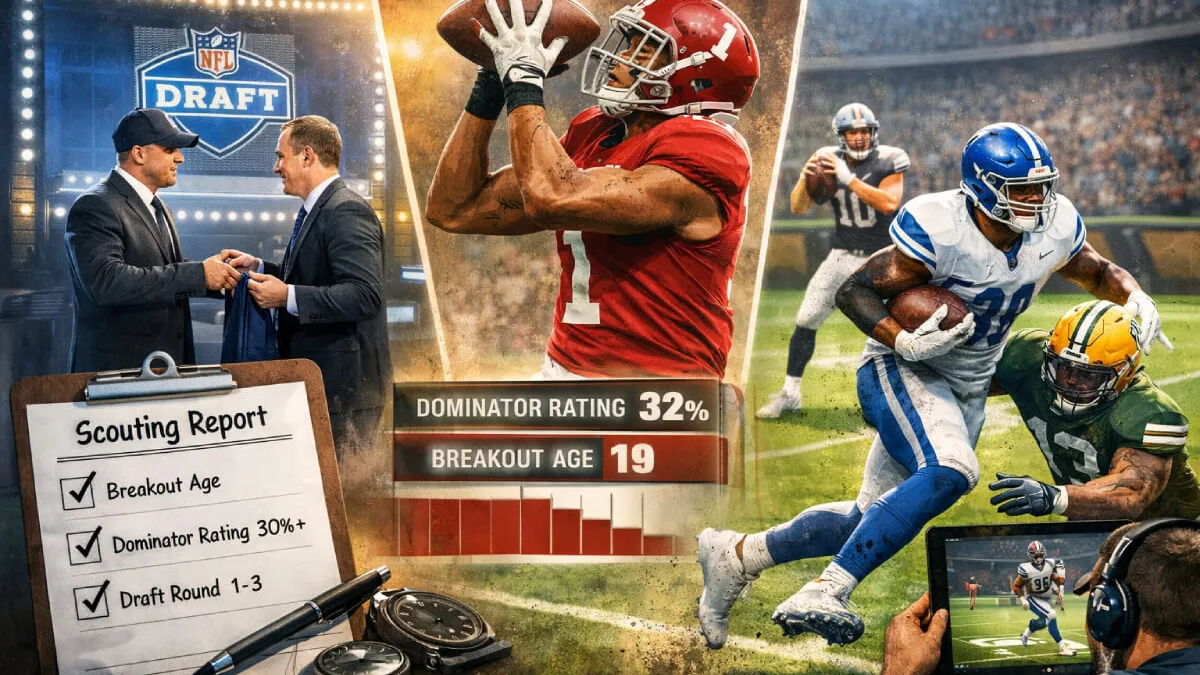
When evaluating rookie wide receivers for fantasy football, three metrics consistently predict success:
- Draft Capital
- College Dominator Rating
- Breakout Age
While physical traits like speed and height grab attention during the NFL Combine, fantasy success is far more closely tied to a receiver’s ability to earn targets early in their career.
In general, the rookie wide receivers with the highest probability of becoming fantasy stars share three characteristics:
- Drafted within the first three rounds
- Produced a 30%+ college dominator rating
- Broke out before age 20
When these traits align, the odds of developing into a fantasy WR1 or WR2 increase dramatically.
Quick Rookie WR Evaluation Checklist
Before diving deeper, here’s a quick framework you can use when scouting rookie wide receivers.
Look for prospects who:
- ✅ Were drafted within the first three rounds
- ✅ Produced a 30%+ dominator rating in college
- ✅ Achieved a breakout age under 20
- ✅ Show evidence of route-running ability and separation
Players who hit these thresholds historically produce the most fantasy-relevant seasons.
Why Rookie Wide Receiver Evaluation Matters More Than Ever
The traditional “three-year wide receiver development curve” is largely gone.
Recent stars have shown that elite prospects can dominate immediately, including players like:
- Justin Jefferson
- Ja’Marr Chase
- Puka Nacua
Each entered the league and quickly became focal points of their offense.
However, for every immediate breakout, dozens of rookie wide receivers fail to produce meaningful fantasy value.
Many of those prospects were elite athletes who dominated the NFL Combine but struggled to earn targets in real games.
The difference between fantasy hits and busts usually comes down to one critical skill:
The ability to consistently earn targets.
How to Evaluate Rookie Wide Receivers for Fantasy Football Using Key Metrics: Moving Beyond the Highlight Reel
Highlight plays can make almost any receiver look like a future superstar.
A one-handed catch or a 70-yard touchdown might go viral, but fantasy football success is built on much more subtle skills.
Elite wide receivers consistently win through:
- Precise footwork at the line of scrimmage
- Efficient route running
- Separation at the top of routes
- Understanding of defensive coverages
These technical traits allow receivers to generate consistent targets, which ultimately drives fantasy production.
In fantasy football, volume is king.
The Three Most Predictive Metrics for Rookie WR Success
When learning how to evaluate rookie wide receivers for fantasy football, three metrics consistently stand out: dominator rating, breakout age, and draft capital.
These three indicators consistently appear in the profiles of fantasy-relevant wide receivers.
1. College Dominator Rating
College Dominator Rating measures how much of a team’s passing offense flowed through one receiver.
The metric averages:
- Team receiving yard market share
- Team receiving touchdown market share
Ideal Threshold
Look for a 30% dominator rating or higher.
Why It Matters
A high dominator rating indicates the receiver was the focal point of their offense.
If a prospect struggled to command targets against college competition, it’s unlikely they will suddenly become a high-volume target earner against NFL defenders.
2. Breakout Age
Breakout age measures the age at which a receiver first achieved a 20% share of their team’s receiving production.
Key Benchmarks
| Breakout Age | Evaluation |
| 18–19 | Elite early breakout |
| 20–21 | Solid prospect |
| 22+ | Potential red flag |
Why It Matters
Early breakout players demonstrate advanced technical ability at a young age.
Historically, receivers who dominate older competition early are more likely to translate their skills to the NFL quickly.
Late breakouts often rely more on physical maturity rather than refined receiver skills.
3. Draft Capital
Draft capital acts as the NFL’s official evaluation of a prospect’s talent.
Teams invest enormous resources in scouting players, and draft position reflects their confidence in that prospect.
Historical Hit Rates
- Round 1 receivers have the highest success rate
- Rounds 2–3 receivers still produce solid fantasy contributors
- Day 3 receivers rarely become long-term fantasy starters
The Sunk Cost Advantage
Teams are motivated to justify early draft investments.
That means early picks receive:
- More playing time
- More designed touches
- Longer developmental patience
Opportunity often follows draft capital.
Film Traits That Translate to Fantasy Production
Analytics can tell us what a receiver produced, but film shows how they win.
Certain technical traits consistently translate from college to the NFL.
Release Package: Winning at the Line of Scrimmage
In college football, elite athletes often win by simply outrunning defenders.
In the NFL, cornerbacks will challenge receivers at the line of scrimmage.
Key traits to watch:
Active Hand Usage
Can the receiver swat away press coverage and maintain their route timing?
Efficient Footwork
Elite receivers have a plan at the line. Suddenness in the first two steps is often more important than long speed.
Beating Press Coverage
Receivers who struggle against press often get limited to slot or flanker roles.
While those roles can still produce fantasy value, they can limit overall target ceilings.
Route Running and Separation
Separation is the most valuable skill for wide receivers in fantasy football.
Receivers who consistently create space generate easier throws and more reliable targets.
Hip Flexibility
At the top of routes, elite receivers sink their hips and explode into the break.
Less refined receivers round off their routes and allow defenders to recover.
Blind Spot Manipulation
Great route runners step into a defender’s blind spot before breaking, making it difficult for the defender to react.
Fantasy Impact
Consistent separators earn high-percentage targets such as slants, outs, and crossers.
In PPR leagues, those targets create a stable weekly scoring floor.
Spatial Awareness Against Zone Coverage
Modern NFL defenses rely heavily on zone coverage.
Receivers must understand how to manipulate defensive spacing.
Finding Soft Spots in Coverage
Great receivers recognize defensive gaps and adjust their routes accordingly.
Quarterback Trust
Quarterbacks quickly learn which receivers consistently sit in open windows.
This trust often leads to increased target volume.
Catch Point Skills and Efficiency Traits
Once a receiver earns a target, their ability to secure the ball and maximize yardage becomes critical.
These efficiency traits separate good receivers from fantasy stars.
Catch Radius and Body Control
Catch radius refers to how much space around their body a receiver can effectively catch the ball.
It depends on more than just height.
Ball Adjustment
Elite receivers track and adjust to off-target throws.
Sideline Awareness
Top receivers can secure catches while keeping both feet in bounds near the sideline.
Fantasy Impact
Receivers with elite body control remain productive even with inconsistent quarterback play.
Hands vs Ball Skills
There is an important distinction between simply having good hands and possessing elite ball skills.
Attacking the Ball
Great receivers attack the ball at its highest point rather than waiting for it to reach their body.
Contested Catch Ability
Winning 50/50 balls can make a receiver a dangerous red-zone threat.
Touchdowns remain one of the fastest ways to generate fantasy points.
Yards After Catch (YAC)
YAC is one of the most valuable traits for fantasy production.
Short receptions can turn into explosive plays when receivers create yardage after the catch.
Examples of elite YAC receivers include players like:
- Deebo Samuel
- Rashee Rice
- A.J. Brown
- Amon-Ra St. Brown
What to Look For
- Smooth transition from receiver to runner
- Ability to maintain momentum after the catch
- Contact balance through arm tackles
Receivers who generate YAC raise both their weekly ceiling and fantasy floor.
Situation vs Talent: The Landing Spot Myth
One of the most common mistakes fantasy managers make is overreacting to a rookie’s landing spot.
While situation matters in the short term, talent almost always wins long term.
Talent Over Situation
Many elite receivers entered the league in poor offensive situations but still produced.
Truly elite receivers eventually command 20–25% target shares regardless of the surrounding roster.
Opportunity alone does not create fantasy stars.
A receiver must still win their matchups to earn targets.
Quarterback Style Matters
While talent is the primary factor, quarterback tendencies can influence rookie production.
Pocket Passers
Traditional quarterbacks often favor precise route runners who separate quickly.
Scrambling Quarterbacks
Mobile quarterbacks often extend plays and target receivers who can uncover during scramble drills.
However, these offenses sometimes produce fewer total pass attempts.
The Year One Path to Playing Time
For rookies to produce fantasy value immediately, they must earn playing time.
Several roles can accelerate that path.
The X Receiver Role
The X receiver lines up on the line of scrimmage and often faces isolated coverage.
If a rookie can consistently win one-on-one matchups in this role, the volume can follow quickly.
Slot Specialists
Slot receivers often generate reliable PPR production through shorter routes.
However, they sometimes have lower touchdown ceilings compared to outside receivers.
Final Thoughts: Building Your Own Rookie Evaluation Model
Mastering how to evaluate rookie wide receivers for fantasy football isn’t about predicting the next superstar perfectly — it’s about consistently identifying players most likely to earn targets at the NFL level.
Scouting rookie wide receivers will never be an exact science.
But combining analytical thresholds with film evaluation can significantly improve your hit rate.
When evaluating prospects, prioritize players who show:
- Early breakout production
- Strong draft capital
- Evidence of separation ability
- High target-earning potential
Above all, remember the most important rule of rookie scouting:
Don’t chase athletic outliers. Chase players who earn targets.
The receivers who consistently win at the line of scrimmage and create separation are the ones most likely to become the next fantasy football stars.