
Why Are These Running Backs Falling in Fantasy Football Drafts?
Several running backs who were once viewed as cornerstone fantasy assets are seeing their value decline entering the 2026 fantasy football season. In most cases, the concerns revolve around age, workload competition, injuries, offensive uncertainty, or unrealistic expectations. While some of these backs can still provide value, fantasy owners should understand why the market is becoming more cautious before draft day.
Understanding the Biggest Running Back Value Drops
Every offseason brings significant movement in fantasy football rankings. Some players rise due to opportunity, while others fall because fantasy owners begin identifying potential risks that weren’t apparent a year ago.
The running back position is especially volatile. A single injury, coaching change, or depth chart addition can dramatically impact fantasy value. The players below aren’t necessarily bad fantasy options, but they are players whose market value has fallen compared to where it stood just last offseason.
Let’s examine the biggest running backs whose stock has fallen entering the 2026 fantasy football season.
Derrick Henry (Ravens)
Why His Stock Is Down
- Finished as an RB1 last season but enters 2026 at an age where many elite running backs historically begin declining.
- Fantasy owners are concerned that age-related efficiency loss could finally arrive.
- Baltimore’s offensive philosophy may evolve under a new system, creating uncertainty about volume.
- Any reduction in carries could significantly impact his fantasy production.
- The market is becoming more cautious despite continued elite production.
Fantasy Recommendation: Henry remains a strong win-now option, but fantasy owners should no longer value him as a locked-in elite RB1.
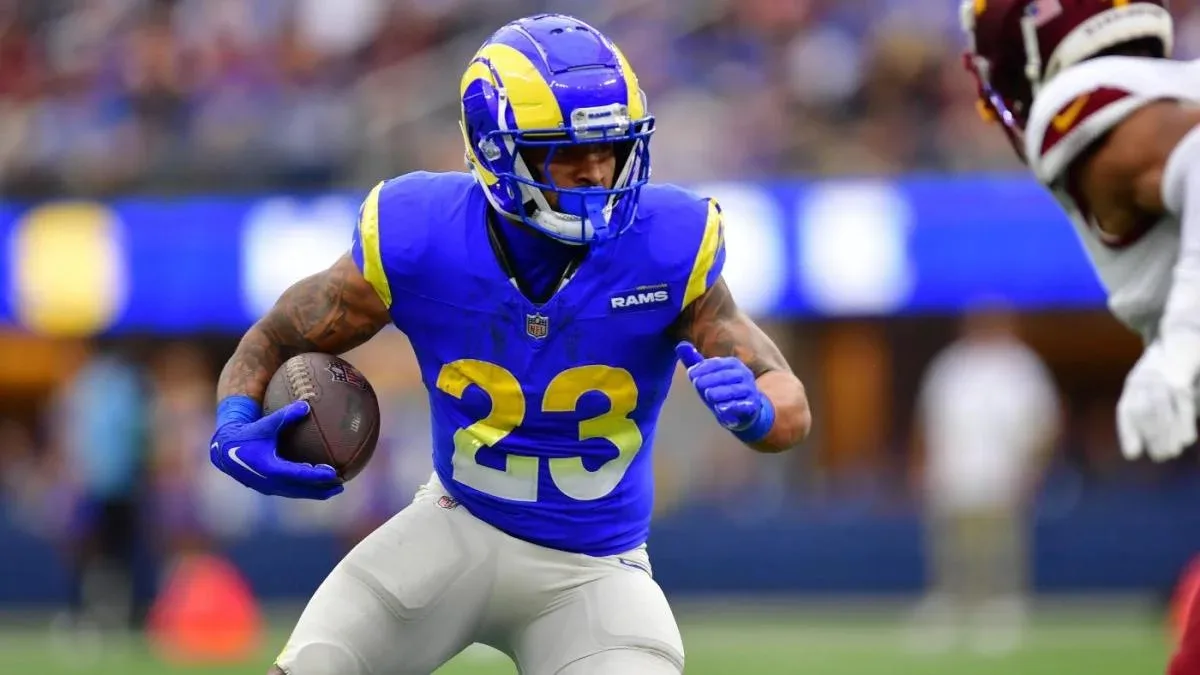
Kyren Williams (Rams)
Why His Stock Is Down
- Touchdown regression concerns are becoming more prominent after multiple highly productive seasons.
- Blake Corum remains a legitimate threat to siphon touches.
- The Rams may look to manage Williams’ workload more effectively.
- Heavy reliance on touchdowns has fantasy owners questioning whether he can repeat prior production.
- Even a modest reduction in goal-line opportunities could significantly impact his rankings.
Fantasy Recommendation: Williams remains a quality starter, but fantasy owners should project him closer to the RB2 range than the elite tier.
Josh Jacobs (Packers)
Why His Stock Is Down
- Off-field legal concerns have introduced uncertainty into his outlook.
- Fantasy owners are worried about potential league discipline or distractions.
- Questions surrounding the Packers offense have lowered projections across the board.
- A decline in offensive efficiency could reduce scoring opportunities.
- Increased risk has pushed him down draft boards compared to previous seasons.
Fantasy Recommendation: Jacobs still offers upside, but fantasy owners should account for the elevated risk when evaluating his draft value.
Saquon Barkley (Eagles)
Why His Stock Is Down
- After a massive debut season in Philadelphia, his touchdown production declined significantly.
- Total yardage also fell well below his peak Eagles campaign.
- Fantasy owners are beginning to worry about an approaching age-related decline.
- Expectations have normalized after an unsustainably productive season.
- The market is questioning whether his elite ceiling remains intact.
Fantasy Recommendation: Barkley remains a capable fantasy starter, but fantasy owners should avoid paying for his peak-season production.
R.J. Harvey (Broncos)
Why His Stock Is Down
- Denver’s backfield became more crowded with the additions of a healthy/returning J.K. Dobbins and rookie Jonah Coleman.
- The path to a workhorse role appears much less likely than it did earlier in the offseason.
- Touch opportunities could become highly situational.
- Reduced volume projections have hurt his fantasy outlook.
- Fantasy owners are becoming increasingly concerned about role security.
Fantasy Recommendation: Harvey is now best viewed as a depth option unless his workload becomes more clearly defined.
Bucky Irving (Buccaneers)
Why His Stock Is Down
- A shoulder injury disrupted what many hoped would be a breakout sophomore campaign.
- Durability concerns have emerged due to his smaller frame.
- Fantasy owners are questioning whether he can consistently handle a heavy workload.
- His stock has steadily declined since the excitement generated by his rookie season.
- Questions remain about whether he can return to full effectiveness.
Fantasy Recommendation: Irving remains an intriguing upside play, but fantasy owners should build in additional injury risk when projecting him.
TreVeyon Henderson (Patriots)
Why His Stock Is Down
- Expectations were extremely high coming out of college.
- He was selected aggressively in rookie drafts based on his athletic profile and upside.
- A timeshare with Rhamondre Stevenson limits his weekly ceiling.
- Henderson also shared workloads throughout much of his college career.
- Fantasy owners are beginning to wonder if he will ever become a true feature back.
- The gap between expectations and actual opportunity has caused his value to slide.
Fantasy Recommendation: Henderson still possesses long-term upside, but fantasy owners should temper expectations until he earns a larger role.
Final Thoughts: Don’t Ignore Falling Running Back Value
Stock declines don’t automatically mean fantasy owners should avoid these players. In many cases, falling value can create buying opportunities if the market overreacts to risk.
The key is understanding why each player’s stock is dropping. Some concerns, such as age and injuries, may be legitimate. Others may simply be creating discounts on talented players who can still outperform expectations.
As draft season approaches, fantasy owners should continue monitoring running backs whose stock has fallen, while paying attention to depth charts, training camp reports, and preseason usage to determine which of these running backs are falling too far.
FAQ: Running Backs Whose Stock Has Fallen
TreVeyon Henderson and R.J. Harvey have seen some of the steepest declines due to workload concerns and increased backfield competition.
Yes. Henry remains productive, but fantasy owners should factor in age-related risk rather than expecting peak-level production.
The biggest concerns are touchdown regression and the possibility of a larger role for Blake Corum.
Not necessarily, but declining production and age-related concerns have lowered his perceived ceiling.
Irving still offers upside, but injury concerns and questions about workload durability have reduced enthusiasm.
It’s possible, but fantasy owners need to see him earn a larger share of the Patriots backfield before projecting a breakout.