
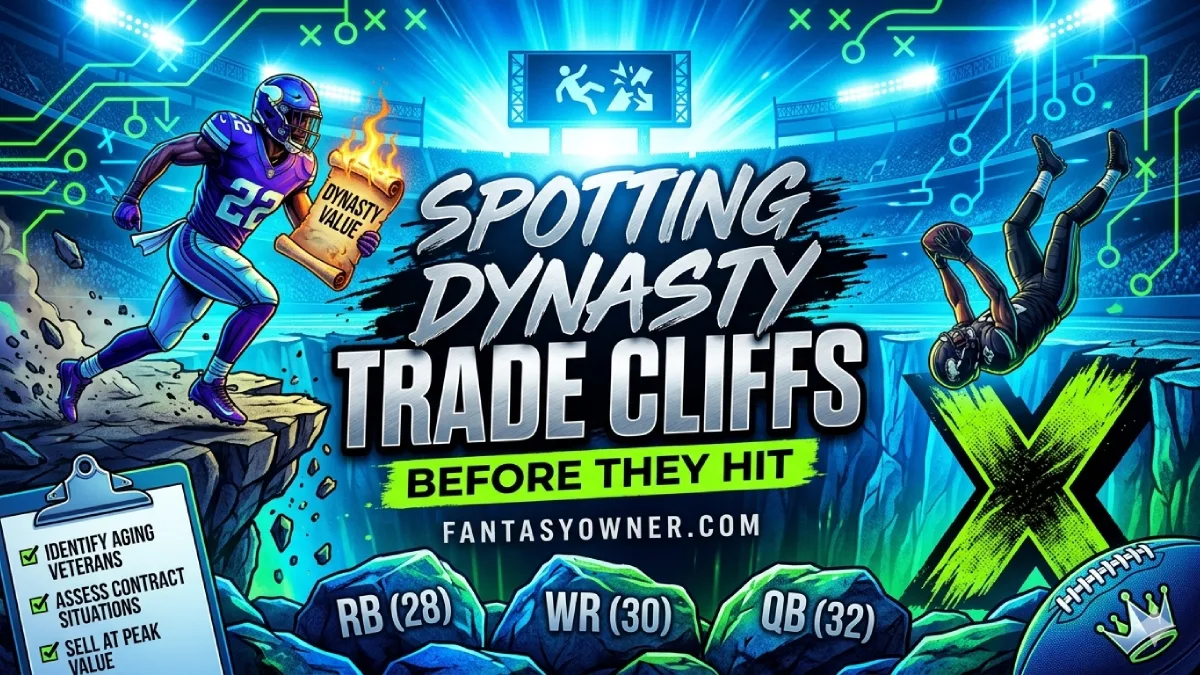
Fantasy owners who consistently win in dynasty leagues often make their biggest moves before everyone else sees trouble coming. Spotting dynasty trade cliffs before the market collapses allows you to maximize player value, avoid aging assets, and maintain a competitive roster year after year.
The key is recognizing when a player’s dynasty value is nearing a steep decline—even if their production still looks strong on the surface.
Why Spotting Dynasty Trade Cliffs Matters
One of the biggest mistakes dynasty fantasy owners make is holding players too long.
Many owners become attached to productive veterans and assume they will have another season or two before their value declines. The problem is that dynasty markets move quickly. Once concerns about age, workload, injuries, or situation become obvious, trade value often falls faster than on-field production.
The best dynasty traders don’t sell when everyone agrees a player is declining. They sell when the market still believes the player is safe.
By spotting dynasty trade cliffs early, fantasy owners can:
- Maximize trade returns
- Acquire younger assets before they become expensive
- Extend championship windows
- Avoid being stuck with depreciating players
- Build long-term roster flexibility
What Is a Dynasty Trade Cliff?
A dynasty trade cliff occurs when a player’s market value drops significantly in a short period of time.
This decline may be caused by:
- Age concerns
- Increased injury risk
- Reduced athleticism
- Decreasing workload
- Contract uncertainty
- Coaching changes
- Emerging competition
- Declining efficiency metrics
Importantly, production often remains strong right before the cliff appears.
That is why many fantasy owners fail to recognize it until the value loss has already happened.
Warning Sign #1: Age Curves Are Approaching
Age alone should never determine dynasty decisions, but it remains one of the strongest indicators of future value.
Every position has historical age ranges where dynasty value becomes more volatile.
Typical Dynasty Risk Zones
Running Backs
- Age 26-28 often marks the beginning of market concern
- Workload history matters as much as age
Wide Receivers
- Value typically remains stable longer
- Significant decline concerns often begin near age 29-31
Quarterbacks
- Usually maintain value well into their 30s
- Rushing quarterbacks often face earlier market corrections
Tight Ends
- Frequently age more gracefully than other positions
- Value can remain stable into their early 30s
The key is understanding that dynasty owners trade future expectations, not current production.
Warning Sign #2: Efficiency Is Falling Before Production
One of the most overlooked indicators of a coming trade cliff is declining efficiency.
A player may still produce fantasy points because of volume, but underlying metrics can reveal growing concerns.
Watch for:
- Declining yards per touch
- Falling yards per route run
- Reduced explosive play rates
- Lower missed tackles forced
- Reduced target earning ability
- Decreasing snap efficiency
When efficiency drops but fantasy production remains intact, fantasy owners often still have a valuable trade window available.
Warning Sign #3: Workload Is Becoming Unsustainable
Volume can hide warning signs for a surprising amount of time.
Veteran players often maintain production because they continue receiving opportunities. However, when the workload begins to decline, the market usually reacts quickly.
Potential red flags include:
- Career-high touch totals
- Multiple seasons with heavy usage
- Increased injury absences
- Reduced snap percentages
- Growing role competition
A player coming off a massive workload season may actually be closer to a dynasty trade cliff than a player whose production appears slightly lower but is trending upward.
Warning Sign #4: Younger Competition Is Emerging
Few things destroy dynasty value faster than younger talent.
Fantasy owners should pay close attention when teams invest significant resources into potential replacements.
Monitor:
- Early-round draft picks
- Expensive free-agent additions
- Increased opportunities for younger players
- Coaching comments about role expansion
- Changes in depth chart positioning
Even before workload changes occur, dynasty owners often begin adjusting player values based on future expectations.
Warning Sign #5: The Narrative Is Changing
Dynasty markets are driven by perception as much as production.
Once owners begin discussing age, injuries, declining explosiveness, or replacement concerns, the market can shift quickly.
Pay attention to:
- Startup draft movement
- Dynasty ranking drops
- Trade calculator declines
- Expert sentiment changes
- Community discussions
By the time the narrative becomes mainstream, the easiest selling window may already be gone.
How to Sell Before the Market Collapses
Selling before a trade cliff doesn’t mean blindly trading every aging player.
Instead, focus on maximizing value.
Ask yourself:
- Can this player’s value realistically increase?
- Is their current market value near its peak?
- Would I buy this player at today’s price?
- Is the risk greater than the potential reward?
If the answers raise concerns, it may be time to explore trade opportunities.
The best dynasty fantasy owners understand that moving off a player one year too early is often better than moving off a player one year too late.
Common Mistakes Fantasy Owners Make
Waiting for Obvious Decline
Once production falls dramatically, the dynasty market usually reacts immediately.
Ignoring Historical Trends
Many fantasy owners believe their player is different from every historical comparison.
Sometimes that is true. Most of the time it isn’t.
Becoming Emotionally Attached
Championship rosters create memories, but dynasty success requires objective decision-making.
Focusing Only on Current Production
Dynasty value is based on future expectations.
A productive player can still be a sell candidate if the market sees significant risk ahead.
Building a Process for Spotting Dynasty Trade Cliffs
Rather than targeting specific players, create a repeatable evaluation process.
Review:
- Age and career workload
- Efficiency trends
- Injury history
- Contract situation
- Team investment in replacements
- Market sentiment
Fantasy owners who consistently evaluate these factors are far more likely to identify dynasty trade cliffs before the broader market reacts.
Final Thoughts
Spotting dynasty trade cliffs is one of the most valuable skills a fantasy owner can develop. The goal is not to predict every decline perfectly. Instead, it’s to recognize when risk is increasing while market value remains strong.
The dynasty owners who consistently gain value are rarely the ones selling after a collapse. They’re the ones who identified the warning signs early and acted before everyone else noticed.
If you can learn to spot dynasty trade cliffs before they hit, you’ll position your roster to remain competitive while continually replenishing long-term value.