
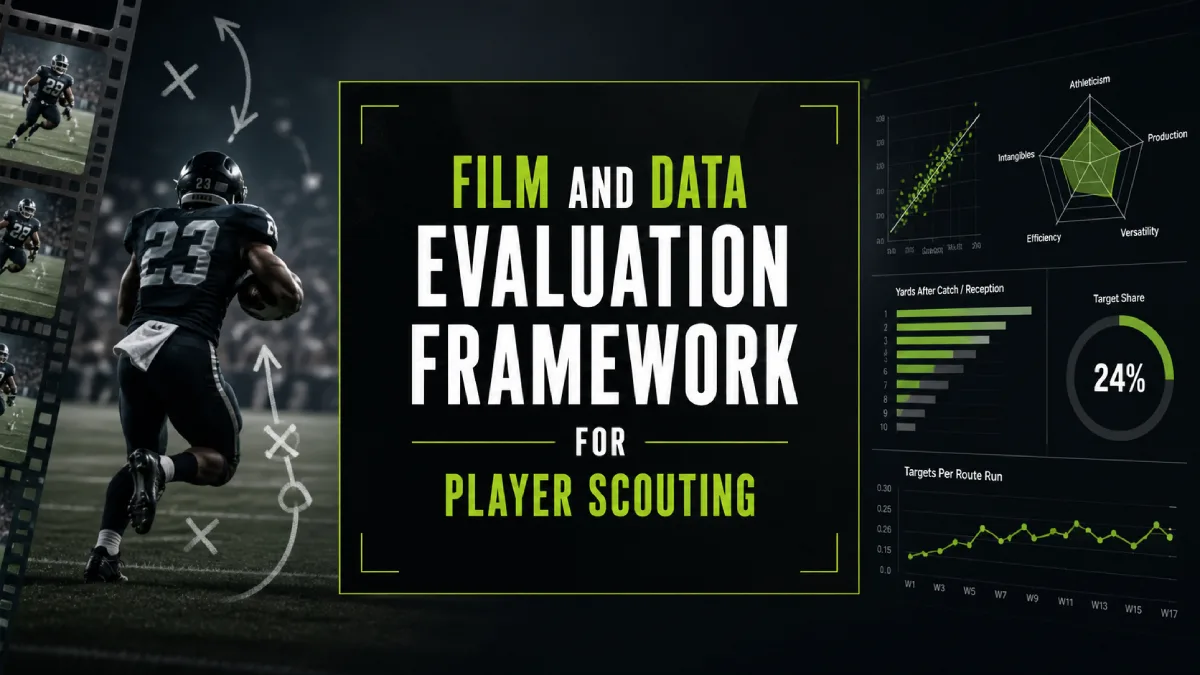
What is a film and data evaluation framework for fantasy football?
A film and data evaluation framework is a repeatable process that combines tape study (what you see) with analytics (what you can measure) to project player performance. Instead of relying on highlights or box scores alone, you score traits on film, validate them with metrics, and then translate both into actionable fantasy decisions like rankings, tiers, and draft targets.
Introduction: Why Film + Data Beats Either Alone
Film tells you how a player wins. Data tells you how often it translates. When you use only one, you invite blind spots—highlight bias on film, or context-free conclusions from stats. A structured film and data evaluation framework closes that gap, improves consistency, and makes your calls defensible (and repeatable) across seasons.
This guide gives you a clean, scannable system you can apply weekly, during draft prep, or for dynasty scouting.
The Core Principles
- Context over conclusions: Scheme, role, teammates, and game scripts shape outcomes.
- Traits before results: Identify transferable skills first; then confirm with production.
- Stability matters: Prioritize sticky metrics (e.g., targets per route) over noisy ones (TD rate).
- Role is king: Volume and usage drive fantasy scoring more than raw talent alone.
- Repeatability: Use the same checklist for every player to avoid bias.
The 5-Step Film + Data Evaluation Framework
1) Define Role & Usage (Start Here)
Film checks
- Alignment (slot vs. out wide; backfield vs. slot for RBs)
- Route tree / carry types
- Down-and-distance usage (3rd downs, red zone, 2-minute)
Data checks
- Routes run, snap share, target share
- Red-zone opportunities, goal-line carries
- Air yards share (WR/TE), route participation rate
Output: Role label (e.g., “full-time slot with red-zone schemed looks”)
2) Grade Translatable Traits (Film First)
Quarterbacks
- Processing speed, pocket movement, accuracy by level, pressure response
Running Backs
- Vision, burst, contact balance, pass protection, receiving chops
Wide Receivers / Tight Ends
- Release package, separation vs. man/zone, ball skills, YAC ability
Scoring (example)
- 1–5 scale per trait → weighted composite (e.g., separation 25%, route nuance 20%)
Output: Trait grade + notes (what wins translate week to week)
3) Validate With Predictive Metrics (Data Layer)
Focus on metrics that correlate with future volume/efficiency:
WR/TE
- Targets per route run (TPRR)
- First-read target rate
- Yards per route run (YPRR)
- Separation proxies (e.g., target depth vs. catch rate splits)
RB
- Opportunity share (carries + targets)
- Targets per route run (for pass-catching role)
- Missed tackles forced / rush (contextual)
- Inside-5 carry share
QB
- Adjusted completion %, pressure-to-sack rate
- EPA/play (contextualized by opponent)
- Designed rush share (fantasy cheat code)
Output: Metric profile (green = confirms film; yellow = neutral; red = conflict)
4) Context & Environment Adjustment
- Scheme: Play-caller tendencies, pace, pass rate over expectation
- Depth chart: Target competition, injury contingencies
- Offensive line / QB play: Efficiency ceiling/floor
- Game script: Team strength, defense quality, likely scripts
Output: Context modifier (e.g., +10% volume upside, −5% efficiency risk)
5) Translate to Fantasy Decisions
- Projection band (floor/median/ceiling)
- Tier placement (who he belongs with)
- ADP delta (value vs. market)
- Action tag: Target, Neutral, Fade
Output: One-line verdict you can use on draft day.
Quick-Scan Checklist
- Role locked? (≥80% routes/snaps)
- Two elite traits on film?
- At least one sticky metric supports it?
- Clear path to volume (injury/competition)?
- Scheme fit amplifies strengths?
If you can’t check at least 3–4 boxes, downgrade.
Example Workflow (WR)
Film
- Wins with releases + intermediate separation; strong YAC angles
Data
- TPRR: 24% (strong)
- YPRR: 2.1 (good)
- Air yards share: 31% (alpha usage)
Context
- New OC increases neutral pass rate; vacated targets available
Verdict
- Tier bump; Target if ADP outside top-18 WRs
Common Mistakes to Avoid
- Highlight scouting: Big plays ≠ consistent traits
- Overweighting TDs: Touchdowns are volatile year to year
- Ignoring role changes: New scheme can break old comps
- Cherry-picking stats: Use a consistent metric set every time
- Recency bias: Anchor to the full-season profile
Building Your Personal Scorecard
Create a simple sheet with:
- Film grades (1–5) for 5–6 traits
- Key metrics (3–5 per position)
- Context flags (scheme, competition, injuries)
- Final outputs (tier, projection band, action tag)
Keep it identical for every player. Consistency beats complexity.
How to Use This During the Season
- Weekly waivers: Prioritize role changes + spike in routes/targets
- Trade windows: Buy when film improves before stats catch up
- Start/Sit: Lean on role + matchup (coverage, run funnel defenses)
Final Takeaway
A disciplined film and data evaluation framework turns opinions into process. When traits, metrics, and context align, you get conviction—and an edge on draft day and beyond.