
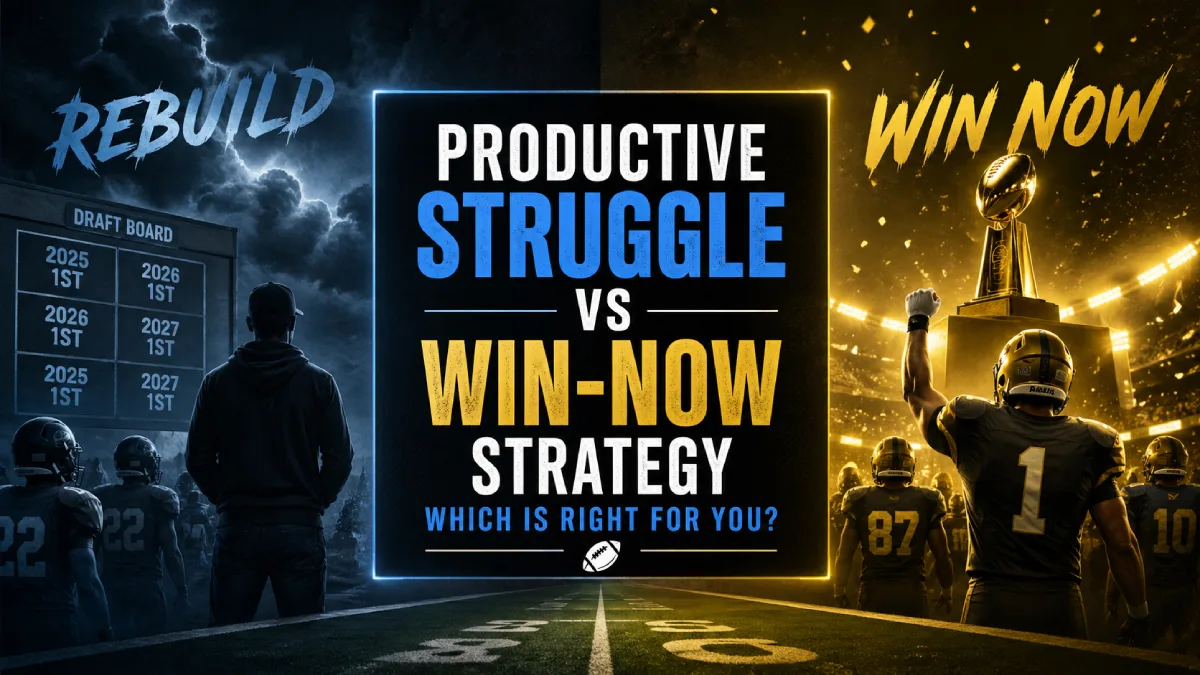
Which is the Right Dynasty Strategy to Take: Productive Struggle or Win-Now?
The productive struggle vs. win-now dynasty decision comes down to your roster’s competitiveness, league dynamics, and risk tolerance. If your team lacks elite talent and depth, a productive struggle (rebuild) is often the smarter long-term play. If you have a strong core and realistic championship odds, a win-now approach maximizes your current window. The key is aligning your strategy with your roster—not forcing a timeline that doesn’t fit.
The Most Important Dynasty Decision to Make
In dynasty fantasy football, few decisions shape your long-term success more than choosing between a productive struggle vs. win-now dynasty approach. Unlike redraft leagues, dynasty formats demand a multi-year mindset, forcing managers to balance present success with future value.
The challenge? Most managers misjudge where their roster truly stands.
This guide breaks down both strategies, when to use them, and how to execute each effectively—so you can build a sustainable contender instead of getting stuck in the middle.
What Is Productive Struggle?
Productive struggle is a deliberate rebuild strategy focused on long-term upside rather than immediate wins.
Core Principles of Productive Struggle
- Prioritize youth and draft capital
- Trade aging veterans at peak value
- Embrace short-term losses for long-term gains
- Accumulate high-upside assets
What Productive Struggle Looks Like
- Starting rookies and second-year players
- Trading RB production for WR longevity
- Stockpiling future 1st-round picks
Why Productive Struggle Works
Dynasty leagues reward elite talent concentration. Productive struggle helps you acquire cornerstone players instead of chasing low-ceiling mediocrity.
What Is a Win-Now Strategy?
A win-now strategy focuses on maximizing your current championship window.
Core Principles of a Win-Now Strategy
- Prioritize proven production
- Trade future picks for veterans
- Optimize weekly lineups for consistency
- Minimize long-term risk
What the Win-Now Strategy Looks Like
- Acquiring aging RBs/WRs at a discount
- Trading rookie picks for starters
- Building depth for playoff pushes
Why the Win-Now Strategy Works
Championships aren’t guaranteed. When you have a real shot, maximizing that window is often the highest EV decision.
Productive Struggle vs. Win-Now Dynasty: Key Differences
| Factor | Productive Struggle | Win-Now |
| Timeline | 2-3 years | Immediate |
| Player Focus | Youth & upside | Proven veterans |
| Draft Picks | Accumulate | Trade away |
| Weekly Wins | Not prioritized | Critical |
| Risk Profile | Long-term variance | Short-term volatility |
How to Decide Which Strategy Is Right
1. Evaluate Your Core Assets
Ask yourself:
- Do I have multiple top-24 players at their position?
- Do I have elite QB/WR building blocks?
If no → Lean productive struggle
If yes → Consider win-now
2. Analyze League Context
Your league matters as much as your roster.
- Are other teams tanking?
- Is the league active in trades?
- How top-heavy are contenders?
Sharp insight: Inactive leagues favor win-now. Active, sharp leagues reward rebuild discipline.
3. Identify Your Championship Window
A true contender typically has:
- 2–3 elite weekly difference-makers
- Depth to survive injuries
- Strong QB play (especially in Superflex)
If you’re missing these, forcing a win-now push often leads to mediocrity.
4. Avoid the “Middle Trap”
The worst place in dynasty is the middle:
- Not good enough to win
- Not bad enough to rebuild effectively
Common mistake: Holding aging players on a non-contending team
Fix: Pick a direction and commit fully.
How to Execute a Productive Struggle
Target Profiles:
- Rookie WRs and Year 2 breakouts
- Injured players with long-term upside
- Backup RBs with future opportunity
Trade Strategy:
- Sell RBs early (short shelf life)
- Trade veterans before decline
- Acquire future 1sts aggressively
Pro Tip: Value insulation matters. Young WRs retain value longer than RBs.
How to Execute a Win-Now Strategy
Target Profiles:
- Veterans undervalued due to age
- High-volume RBs on playoff teams
- Consistent WR2/WR3 producers
Trade Strategy:
- Package picks for starters
- Overpay slightly for elite production
- Add depth for playoff insurance
Pro Tip: Depth wins championships. Your RB3 matters in Week 15.
Hybrid Strategy: When It Makes Sense
Not every roster is binary.
A hybrid approach works when:
- You’re competitive but not dominant
- You have young core players already producing
- You can contend without sacrificing all future value
Example:
- Keep elite young WRs
- Trade picks for one difference-making RB
- Stay flexible at the trade deadline
Common Mistakes to Avoid
- Rebuilding Too Late: Waiting until your roster collapses kills asset value.
- Chasing Points Without a Window: Adding veterans to a 6th-place team rarely works.
- Overvaluing Draft Picks: Picks are tools—not goals.
- Refusing to Pivot: Dynasty success requires adaptability year to year.
Final Thoughts
The productive struggle vs. win-now dynasty decision isn’t about preference—it’s about alignment.
- Bad team? Rebuild with purpose.
- Good team? Push for the title.
- Somewhere in between? Decide quickly.
Dynasty leagues reward clarity and commitment. The managers who consistently win aren’t guessing—they’re executing a defined strategy.