
The Toughest TE Draft Calls for Fantasy Owners
What are the toughest fantasy football tight end decisions in 2026 drafts? The hardest choices come when two tight ends carry similar ADPs, comparable projections, and legitimate top-five upside. Making the right selection can provide a weekly positional advantage that few fantasy owners enjoy.
Unlike other positions, elite tight ends create separation because there are so few true difference-makers. Whether you’re deciding between established veterans, ascending young stars, or breakout candidates, understanding each player’s role, target share, offensive environment, and touchdown upside can help break the tie.
Let’s examine the biggest fantasy football tight end decisions facing fantasy owners in 2026 drafts.
Trey McBride or Brock Bowers
The Case for Trey McBride
Trey McBride has become one of the safest weekly producers at the position thanks to his elite target volume. Arizona funnels its passing game through him, giving him one of the highest reception floors among all tight ends.
Fantasy owners should love McBride because of his:
- Elite target share
- Outstanding PPR value
- Reliable weekly consistency
- Ability to create yards after the catch
- High snap percentage
McBride rarely disappears from a game plan, making him an ideal anchor for fantasy owners who value stability.
The Case for Brock Bowers
Brock Bowers possesses arguably the highest overall ceiling at the position. His rare athleticism allows him to function more like a true WR1 than a traditional tight end, creating matchup nightmares across the field.
Reasons fantasy owners draft Bowers:
- Explosive playmaking ability
- Massive yard-after-catch upside
- Elite athletic profile
- High touchdown ceiling
- Overall TE1 potential
Few tight ends can completely take over games the way Bowers can.
Fantasy Football Tight End Decision: McBride offers unmatched weekly consistency through volume, while Bowers provides the highest explosive upside at the position.
Colston Loveland or Tyler Warren
The Case for Colston Loveland
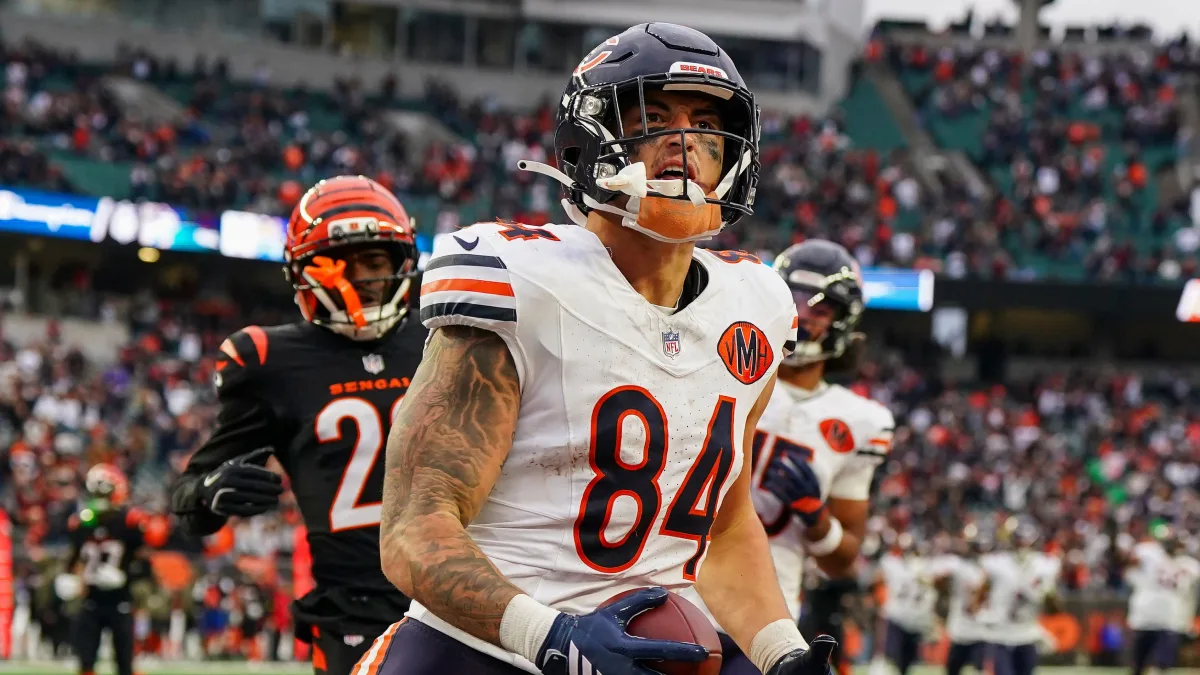
Colston Loveland enters his second season with tremendous breakout potential in Chicago’s improving offense. His polished route running and natural receiving skills make him a quarterback’s best friend.
Loveland’s strengths include:
- Excellent receiving ability
- Strong route-running
- Growing target share
- High PPR upside
- Expanding offensive role
His profile resembles the modern pass-catching tight end fantasy owners covet.
The Case for Tyler Warren
Tyler Warren projects as the centerpiece of Indianapolis’ short and intermediate passing attack. His physical style and versatility allow him to contribute in every situation.
Fantasy owners may prefer Warren because of his:
- Complete three-down skill set
- Strong red-zone potential
- Reliable snap share
- High-volume opportunity
- Well-rounded fantasy profile
His balanced usage creates both a solid floor and exciting upside.
Fantasy Football Tight End Decision: Loveland offers more explosive receiving upside, while Warren’s all-around role may produce steadier week-to-week fantasy production.
Tucker Kraft or Harold Fannin Jr.
The Case for Tucker Kraft
Tucker Kraft continues to emerge as one of Green Bay’s most trusted offensive weapons. His ability after the catch and increasing red-zone involvement make him an intriguing breakout candidate.
Fantasy owners like Kraft because of his:
- Strong athleticism
- Increasing touchdown opportunities
- Reliable snap count
- Physical running style
- Ascending offensive role
If his target share continues to grow, Kraft could easily outperform his draft position.
The Case for Harold Fannin Jr.
Harold Fannin Jr. enters 2026 with significant momentum after flashing elite receiving traits. Cleveland views him as a long-term offensive weapon capable of stretching defenses and creating mismatches.
Reasons fantasy owners are excited:
- Elite receiving upside
- Dynamic after-the-catch ability
- Massive breakout potential
- Vertical playmaking skills
- Long-term TE1 ceiling
Fannin has the type of athletic profile capable of producing league-winning value if his role expands.
Fantasy Football Tight End Decision: Kraft has to work his way back from an injury but ultimately holds a tremendously high ceiling capable of Top 3 tight end production.
Kyle Pitts or Sam LaPorta
The Case for Kyle Pitts
Kyle Pitts continues to tempt fantasy owners because of his rare athletic profile. Few tight ends possess his combination of size, speed, and downfield receiving ability.
Reasons to believe in Pitts:
- Elite physical traits
- Massive big-play potential
- Red-zone mismatch ability
- High yardage ceiling
- Opportunity for a true breakout
Fantasy owners willing to bet on talent continue to see Pitts as one of the biggest upside plays at tight end.
The Case for Sam LaPorta
Sam LaPorta has already established himself as one of the NFL’s premier fantasy tight ends. Detroit consistently schemes touches for him in high-value situations.
LaPorta offers:
- Reliable weekly production
- Excellent touchdown upside
- Strong target consistency
- High-scoring offense
- Proven fantasy success
His combination of floor and ceiling makes him one of the safest options available.
Fantasy Football Tight End Decision: Pitts offers the tantalizing ceiling fantasy owners have chased for years, while LaPorta provides the far more dependable weekly production.
Travis Kelce or George Kittle
The Case for Travis Kelce
Travis Kelce remains one of fantasy football’s most accomplished players. Even as he enters the later stages of his career, his chemistry with Patrick Mahomes continues to generate premium fantasy opportunities.
Fantasy owners still value Kelce because of his:
- Elite football IQ
- Strong red-zone usage
- Proven postseason and regular-season production
- Reliable target volume
- Hall of Fame consistency
Experience and offensive stability continue to work in Kelce’s favor.
The Case for George Kittle
George Kittle remains one of the most complete players at the position. His combination of blocking, receiving, and yards-after-the-catch ability creates enormous fantasy upside whenever volume follows.
Kittle’s strengths include:
- Elite efficiency
- Big-play capability
- Strong touchdown upside
- Physical running style
- Weekly difference-making potential
Few tight ends are capable of posting 100-yard, multi-touchdown performances as often as Kittle.
Fantasy Football Tight End Decision: Kelce’s age and Kittle’s return from an injury have caused these two titans of the game to slide. But Kelce still offers a safe fantasy floor in Kansas City’s offense, while Kittle — when he returns — brings greater explosive-play upside and the potential for bigger weekly performances.
Final Thoughts on Fantasy Football Tight End Decisions
The best fantasy football tight end decisions often come down to understanding your roster-building philosophy. Some fantasy owners prioritize dependable target volume and weekly consistency, while others are willing to chase elite athletic upside and league-winning ceilings.
When breaking ties between closely ranked tight ends, focus on the factors that matter most:
- Target share
- Offensive environment
- Red-zone opportunities
- Weekly consistency
- Overall positional ceiling
Making smart fantasy football tight end decisions during your draft can provide a significant positional advantage that lasts all season long.