
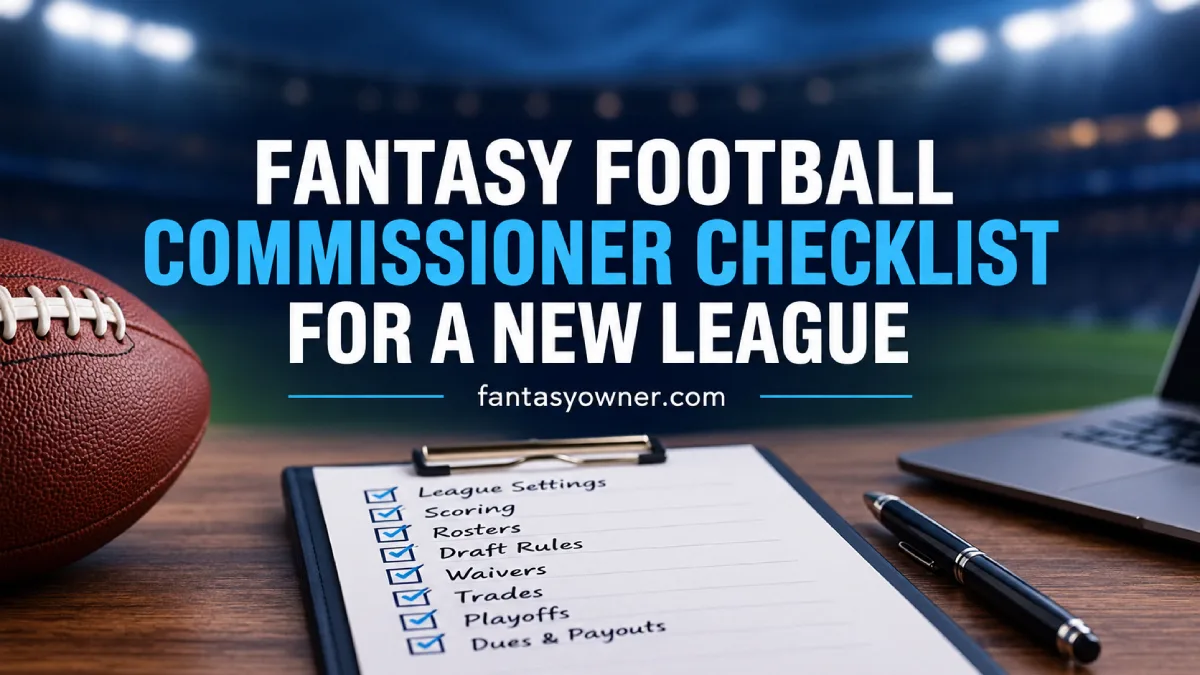
How do you start a new fantasy football league? A successful new league starts with a clear fantasy football commissioner checklist covering league members, scoring, roster settings, rules, waivers, trades, playoffs, dues, and the draft. Set the important decisions before the first pick, communicate them to every fantasy owner, and document the rules in one place.
Starting a fantasy football league should be fun—not a summer-long exercise in putting out fires. A little preparation before the season can prevent many of the arguments and confusion that can derail a league later.
Whether you’re creating a casual league with friends, starting a competitive league, or taking over as commissioner for the first time, this fantasy football commissioner checklist will help you build the league from the ground up.
Fantasy Football Commissioner Checklist: League Setup
Before inviting everyone into the league, establish the basic structure.
Choose the League Size
Decide how many fantasy owners you want before creating the league.
Common options include:
- 8 teams: Deeper rosters and plenty of high-end talent available.
- 10 teams: A good balance of player availability and competition.
- 12 teams: A traditional format that creates a deeper player pool and more difficult roster decisions.
- 14+ teams: Better suited for experienced fantasy owners who want a significantly deeper league.
For a first league, 10 or 12 teams is usually a straightforward place to start.
Choose Redraft, Keeper or Dynasty
Determine how long rosters carry over from one season to the next.
Redraft: Every fantasy owner starts from scratch each season.
Keeper: Fantasy owners retain a limited number of players from one season to the next.
Dynasty: Rosters carry over from year to year, usually with deeper rosters and rookie drafts.
Don’t introduce keeper or dynasty rules casually. Those formats require significantly more planning around contracts, player retention, rookie drafts, trades and future draft picks.
Choose the Fantasy Football Platform
Pick a platform that supports the league format and settings you want to use.
Before committing, make sure it supports:
- Your scoring system
- Roster configuration
- Waiver system
- Trades
- Playoffs
- Keeper or dynasty settings, if applicable
- Commissioner controls
- Draft format
The platform should make the league easier to operate—not force you to create complicated workarounds.
Set the League’s Scoring Rules
Scoring is one of the most important parts of your fantasy football commissioner checklist.
Decide exactly how players earn points before the draft.
Offensive Scoring
Determine the value of:
- Passing yards
- Passing touchdowns
- Interceptions
- Rushing yards
- Rushing touchdowns
- Receptions
- Receiving yards
- Receiving touchdowns
- Two-point conversions
- Fumbles
Also decide whether your league uses:
- Standard scoring
- Half-PPR
- Full PPR
- Superflex
- Custom scoring
Defensive and Kicker Scoring
If your league uses team defenses or kickers, establish those scoring rules as well.
For defenses, determine how points are awarded for:
- Sacks
- Interceptions
- Fumble recoveries
- Defensive touchdowns
- Safeties
- Points allowed
- Yards allowed
For kickers, establish scoring for:
- Field goals
- Extra points
- Missed kicks
- Distance-based field goals
The important thing isn’t which scoring system you choose. It’s that every fantasy owner knows exactly what the system is before drafting.
Build the Rosters
Next, determine what every team will look like.
A typical roster may include:
- QB
- RB
- WR
- TE
- FLEX
- K
- DST
- Bench
You can also consider:
- Superflex
- Multiple FLEX positions
- Additional WR or RB slots
- IDP positions
- IR slots
- Taxi squads
- Deeper benches
Keep the format as simple as possible unless your league specifically wants additional complexity.
Create the League Rules
Every new league should have a written set of rules.
This doesn’t need to be a 30-page constitution. A concise document covering the important decisions is usually enough.
Your league rules should address:
Draft Rules
Define:
- Draft date and time
- Draft format
- Draft order
- Pick timer
- Snake or auction format
- Autodraft procedures
- Missed-pick procedures
- Draft-day technical issues
Waiver Rules
Determine how free agents are acquired.
Common options include:
- FAAB
- Rolling waivers
- Reverse standings
- Free-agent priority
- First-come, first-served
If using FAAB, establish the starting budget and whether unused money carries over.
Trade Rules
Decide:
- Whether trades require review
- Who reviews trades
- How long the review period lasts
- What constitutes collusion
- Whether the commissioner can overturn trades
- When the trade deadline occurs
- Whether future draft picks can be traded
Be especially clear about the difference between an unpopular trade and a collusive trade.
Playoff Rules
Determine:
- Number of playoff teams
- Playoff weeks
- Playoff seeding
- Tiebreakers
- Whether playoff matchups reseed
- Whether there is a consolation bracket
- How the championship is determined
Don’t wait until the playoffs to figure out what happens in a tie.
Establish League Dues and Payouts
If the league has a buy-in, settle the money before the draft.
Your fantasy football commissioner checklist should include:
- Entry fee
- Payment deadline
- Payment method
- Prize pool
- First-place payout
- Second-place payout
- Third-place payout, if applicable
- Other prizes
- Last-place punishment, if applicable
Put the payout structure in writing.
The goal is to eliminate questions such as, “Wait, how much does second place get?”
If someone hasn’t paid by the deadline, have a clearly established policy for whether that fantasy owner is allowed to draft.
Confirm Every Fantasy Owner
Before the draft, make sure every roster spot has been filled.
Check that:
- Every fantasy owner has accepted the invitation.
- Everyone has created their team.
- Team names are finalized.
- Everyone understands the league format.
- Everyone has access to the league rules.
- Everyone knows the draft date and time.
- Everyone knows how to access the draft room.
For a new league, it’s also worth confirming that every fantasy owner understands the basic scoring and roster format before draft day.
Set the Draft Date and Order
Once the league is populated, lock in the draft.
Send every fantasy owner:
- Draft date
- Draft time
- Time zone
- Draft location or online link
- Draft format
- Pick timer
- Draft order
- Instructions for joining
Then determine how the draft order will be selected.
Possible options include:
- Randomized order
- Lottery
- Previous-season standings
- Reverse standings
- A commissioner-approved method
- A league-specific competition
Whatever method you use, explain it beforehand.
Prepare for Draft Day
A commissioner should have a plan for problems before they happen.
Draft-Day Checklist
- Test the draft room.
- Confirm the draft timer.
- Verify the draft order.
- Make sure everyone can log in.
- Have a backup communication channel.
- Have a backup internet connection if necessary.
- Know how to pause the draft.
- Know how to handle an accidental pick.
- Have a backup plan if the platform goes down.
- Save a copy of the league rules.
If you’re hosting an in-person draft, also consider:
- Seating
- Wi-Fi
- Chargers
- Extension cords
- Draft board
- Printed rankings
- Food
- Drinks
A draft can be competitive without being chaotic.
Lock the Rules Before the Season
One of the most important jobs on a fantasy football commissioner checklist is knowing when the rules are final.
Set a firm deadline for rule changes.
Ideally, major rules should be finalized before the draft. Once the season begins, changing rules that affect competitive balance can create unnecessary controversy.
If a rule needs to change during the season because of an unusual situation, explain the change clearly and apply it consistently.
Create a Communication Plan
Decide where league communication will happen.
This might be:
- League message board
- Group text
- Discord
- Slack
- Platform chat
The specific tool doesn’t matter as much as having one reliable place for important announcements.
Use the league’s communication channel for:
- Rule announcements
- Waiver reminders
- Trade deadlines
- Draft reminders
- Schedule announcements
- Playoff information
- League votes
- Important commissioner decisions
Don’t bury important rules in a six-month-old group-text conversation.
Final Commissioner Checklist Before the Draft
Run through this list before the first pick.
League
- League size finalized
- Every fantasy owner confirmed
- League format selected
- Platform selected
- Team names finalized
Scoring
- Scoring system finalized
- Passing scoring confirmed
- Rushing scoring confirmed
- Receiving scoring confirmed
- Defensive scoring confirmed
- Kicker scoring confirmed
- Bonuses and penalties confirmed
Rosters
- Starting lineup finalized
- Bench size finalized
- FLEX settings finalized
- Superflex settings finalized, if applicable
- IR settings finalized
- IDP settings finalized, if applicable
Rules
- Draft rules documented
- Waiver rules documented
- Trade rules documented
- Trade deadline established
- Playoff format established
- Tiebreakers established
- Rule-change process established
Money
- Entry fee established
- Payment deadline established
- All payouts documented
- Last-place punishment established, if applicable
Draft
- Draft date confirmed
- Draft time confirmed
- Time zone confirmed
- Draft order determined
- Draft timer established
- Backup plan established
Communication
- League rules distributed
- Draft information distributed
- Communication channel established
- Important deadlines communicated
What to Do After the Draft
The commissioner’s job doesn’t end when the draft finishes.
Immediately after the draft:
- Verify every roster.
- Check for accidental selections or duplicate players.
- Confirm waiver settings.
- Confirm lineup settings.
- Verify the schedule.
- Confirm the playoff settings.
- Review the league standings page.
- Send a draft recap.
- Remind everyone about the first waiver deadline.
It’s much easier to fix a league-setting mistake immediately than discover it five weeks into the season.
How to Run a New Fantasy Football League Successfully
The best commissioners aren’t necessarily the ones who create the most complicated leagues. They’re the ones who create clear expectations, enforce the rules consistently, communicate well and keep the league enjoyable.
Use this fantasy football commissioner checklist as your starting point, then customize it for your league’s format.
Before the first pick, every fantasy owner should know what they’re playing for, how the league works, how points are scored, how players are acquired, how trades are handled and how a champion will be determined.
Get those decisions right before the season starts, and you’ll spend much less time solving avoidable problems once the games begin.
Fantasy Football Commissioner FAQ
A commissioner should establish the league size, format, scoring system, roster settings, draft rules, waiver rules, trade rules, playoff structure, dues and payouts before the season begins. The commissioner should also communicate the rules to every fantasy owner.
Every league should clearly define scoring, roster requirements, draft procedures, waivers, trades, trade deadlines, playoffs, tiebreakers, dues and payouts. Keeper and dynasty leagues also need rules covering player retention and future seasons.
Ten or 12 teams are common choices for a new fantasy football league. Ten-team leagues generally provide a deeper free-agent pool, while 12-team leagues create more roster scarcity and tougher lineup decisions.
League rules should be finalized before the draft. Major changes should generally be avoided once the season begins because changing competitive settings midseason can create disputes.
The league should establish its trade-review process before the season. Many leagues reserve commissioner intervention for clear collusion or rules violations rather than overturning trades simply because they appear unbalanced.
The commissioner should make sure the draft room is ready, confirm the draft order and timer, help resolve technical problems, enforce the established rules and keep the draft moving. A backup plan is useful in case the platform or internet connection fails.
The most important job is maintaining a fair, clearly communicated and enjoyable league. A commissioner should establish expectations before problems occur and apply the league’s rules consistently throughout the season.