
What We Learned From Week 2 of Fantasy Football
Week 2 provided even more information about which early-season performances are real and which may have been misleading. Several quarterbacks continued to produce at a high level, while injuries created uncertainty for some of the biggest names in fantasy football.
The running back position also delivered a major development in New England, while several wide receivers either strengthened their early-season cases or created significant concerns for fantasy owners.
Two weeks is still a small sample size, but usage, opportunity and offensive roles are beginning to tell a clearer story.
Here are the biggest Week 2 fantasy football takeaways heading into Week 3.
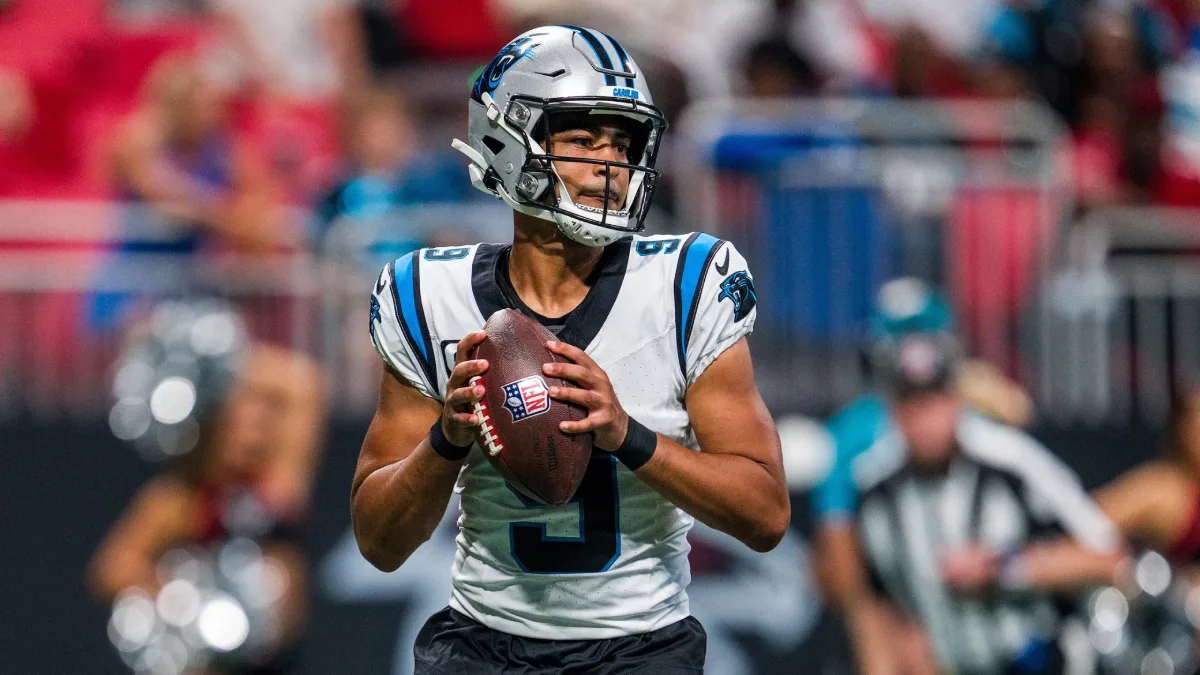
1. Bryce Young Is Becoming a Legitimate Fantasy Streamer
Bryce Young is making it increasingly difficult to dismiss his Week 1 breakout as a fluke.
Young completed 23 of 36 passes for 287 yards and three touchdowns in Week 2, giving him more than 285 passing yards and three touchdowns in each of his first two games.
That’s an impressive level of consistency, particularly for a quarterback who wasn’t widely viewed as a dependable fantasy option entering the season.
Young isn’t suddenly an automatic weekly starter in every format, but his combination of passing volume and touchdown upside has pushed him firmly into the QB2 streaming conversation.
Takeaway: Young has earned a spot on the fantasy radar, particularly in favorable matchups.
2. Tyler Shough Continues to Fuel a Fantasy-Friendly Saints Offense
Tyler Shough followed up his massive Week 1 performance with another strong outing, throwing for 252 yards and a touchdown in New Orleans’ victory over Baltimore.
The raw numbers weren’t as explosive as his 410-yard debut, but that’s actually part of what makes the early results encouraging. Shough didn’t need another massive passing day to remain productive.
Through two weeks, he’s sitting among the top-five fantasy quarterbacks, while the Saints’ passing game has become a legitimate source of fantasy production.
The turnovers and efficiency still deserve monitoring, but the volume has made Shough considerably more relevant than he was entering the season.
Takeaway: Shough has moved from intriguing Week 1 streamer to a quarterback fantasy owners need to take seriously.
3. Injuries Are Creating Immediate Quarterback Concerns
Week 2 delivered a reminder of how quickly quarterback depth can change.
Caleb Williams suffered a fourth-quarter hamstring injury on a non-contact scramble and was forced to leave the game. The severity remains important to monitor because Williams’ rushing ability is a major component of his fantasy value.
Jayden Daniels also exited his game early with an injury, creating another immediate problem for fantasy owners relying on an elite rushing quarterback.
Neither situation should be overanalyzed until more information is available, but fantasy owners should be prepared for the possibility of short-term absences.
Takeaway: Injuries to mobile quarterbacks can have an especially significant fantasy impact because rushing production is often a major part of their weekly floor.
4. TreVeyon Henderson Immediately Changed the Patriots’ Backfield
TreVeyon Henderson wasted no time making his presence felt after missing Week 1.
He took over a significant role in New England’s backfield and provided the explosiveness the offense needed. Meanwhile, Rhamondre Stevenson struggled with ball security, creating an opportunity for Henderson to strengthen his grip on the workload.
It is too early to call this a complete takeover, but Henderson’s immediate impact is difficult to ignore.
His combination of explosiveness and opportunity gives him legitimate RB2 upside moving forward.
Takeaway: Henderson has quickly become one of the most important backfield situations to monitor heading into Week 3.
5. Marvin Harrison Jr. Has Become a Major Concern
Few Week 2 developments were more frustrating for fantasy owners than Marvin Harrison Jr.’s continued lack of involvement.
Harrison ran a limited number of routes and finished with one target and zero catches. Through two games, he has just one reception on four total targets.
That level of usage is extremely difficult to reconcile with the draft capital fantasy owners invested in him.
There is still plenty of time for Arizona to correct the issue, and Harrison’s talent hasn’t disappeared. But at this point, fantasy owners have to pay attention to the actual usage rather than simply assuming the targets will eventually arrive.
Takeaway: Harrison’s talent makes him difficult to abandon, but his role and target volume have become legitimate fantasy concerns.
6. Jaylen Waddle Gets His Bounce-Back Game
After a disappointing Week 1, Jaylen Waddle responded exactly the way fantasy owners wanted.
Waddle caught 8 of 10 targets for 138 yards, immediately putting his early-season dud into better perspective.
One bad game can happen for any receiver. The more important question is whether the underlying role remains strong. Waddle’s Week 2 target volume provides encouraging evidence that his Week 1 performance was an outlier rather than a sign of a diminished role.
Takeaway: Waddle’s Week 2 explosion is a good reminder not to overreact to one bad fantasy performance.
7. Jaxon Smith-Njigba is THE Elite WR1
Jaxon Smith-Njigba delivered one of the biggest fantasy performances of Week 2.
He caught three touchdowns, including an 82-yard bomb from Drew Lock, producing a massive PPR performance against Arizona.
The touchdowns naturally inflated the fantasy score, but the bigger takeaway is the continued emergence of Smith-Njigba as the premier receiving option.
His role has progressed beyond simply being a promising young receiver. He’s now producing like a player who belongs in the WR1 overall conversation.
Takeaway: Smith-Njigba’s combination of target volume, big-play ability and scoring upside has pushed him firmly into the WR1 discussion.
8. Tetairoa McMillan Shows His Week 1 Performance Was Temporary
Tetairoa McMillan provided another encouraging bounce-back performance for fantasy owners.
After a modest Week 1, McMillan caught five passes for 101 yards, showcasing the downfield ability that made him such an intriguing fantasy player entering the season.
The 100-yard performance is particularly encouraging because it demonstrates that his fantasy value doesn’t depend exclusively on short-area volume. He can create explosive plays and generate production downfield.
Takeaway: McMillan looks like a legitimate WR2 option with big-play upside rather than a player fantasy owners should have abandoned after one quiet game.
9. Don’t Panic Over a Quiet Justin Jefferson Game
Justin Jefferson delivered an unusually quiet fantasy performance in Minnesota’s 9–3 defensive battle against Chicago.
That’s obviously disappointing for fantasy owners, but the game environment provides important context. Minnesota’s offense had very little scoring opportunity in a game dominated by defense and constant rain.
Elite players will occasionally produce floor games, particularly when their offenses struggle to generate points.
One quiet afternoon shouldn’t change how fantasy owners view Jefferson.
Takeaway: Treat Jefferson’s Week 2 performance as a bad game environment rather than evidence that his role or talent has changed.
10. Ashton Jeanty Reminds Us Why One Week Isn’t a Trend
Ashton Jeanty’s Week 2 performance was the exact opposite of his explosive debut.
After posting over 30 PPR points in Week 1, Jeanty struggled to find running room against the Chargers and produced a major fantasy disappointment.
That doesn’t erase what we learned in Week 1. Jeanty still demonstrated that Las Vegas is willing to give him a substantial workload. The bigger question is how efficiently he can turn that opportunity into production against tougher defensive fronts.
Fantasy owners shouldn’t expect every week to look like his debut, just as they shouldn’t assume Week 2 represents his new normal.
Takeaway: Jeanty’s disappointing Week 2 is a reminder that even high-volume backs will have inefficient games.
What These Week 2 Fantasy Football Takeaways Mean for Week 3
The biggest lesson from Week 2 is that context matters just as much as the box score.
Bryce Young and Tyler Shough have now produced strong fantasy numbers in consecutive weeks, making their early success increasingly difficult to dismiss. TreVeyon Henderson has potentially changed the outlook of New England’s backfield, while Marvin Harrison Jr.’s lack of involvement has become a much more serious concern.
Meanwhile, Jaylen Waddle and Tetairoa McMillan showed why fantasy owners shouldn’t make major decisions based on one poor (or modest) performance. Justin Jefferson and Ashton Jeanty provided the opposite reminder: even elite fantasy assets can produce disappointing weeks without necessarily experiencing a meaningful change in role.
And, as always, injuries need to be monitored closely. The situations involving Caleb Williams and Jayden Daniels could have major implications for both their fantasy value and the value of their teammates.
The Bottom Line on Week 2 Fantasy Football Takeaways
Week 2 gave fantasy owners a much clearer picture of several players who stood out in the opening week.
Bryce Young and Tyler Shough are becoming legitimate fantasy options, while TreVeyon Henderson has emerged as one of the most important backfield situations to watch. Jaxon Smith-Njigba continues to strengthen his case as an elite receiver, and Jaylen Waddle and Tetairoa McMillan showed the value of staying patient after a disappointing Week 1.
At the same time, Marvin Harrison Jr.’s lack of involvement has become a legitimate concern, while injuries to Caleb Williams and Jayden Daniels could create immediate lineup problems.
The biggest takeaway heading into Week 3 is simple: two weeks of usage are starting to reveal real trends, but it’s still too early to treat every result as permanent.
Fantasy owners should focus on the players whose roles, opportunities and underlying usage are changing—not simply the players who happened to score the most or least fantasy points in Week 2.