
How to Make Tough Week 3 Start/Sit Decisions
Week 3 is where fantasy football start/sit decisions begin to take shape. By now, fantasy owners have two weeks of actual game data to evaluate, but it is still important not to overreact to small sample sizes.
The key to making Week 3 start/sit decisions is finding the right balance between recent usage, expected workload, matchup, and offensive environment. A player’s role can tell us plenty, but the opponent and projected game script can determine whether that role translates into fantasy production.
Here are some of the toughest Week 3 lineup decisions at quarterback, running back, wide receiver, and tight end.
Quarterback Start/Sit Decisions
Patrick Mahomes vs. Jared Goff
Start: Patrick Mahomes, KC (@ MIA)
Patrick Mahomes gets the nod in this matchup because of his elite multi-touchdown upside.
Kansas City travels to Miami for a warm-weather matchup that should provide opportunities for the Chiefs’ passing game. Mahomes’ combination of passing volume, touchdown potential, and playmaking ability gives him one of the highest ceilings on the Week 3 slate.
Jared Goff has the benefit of playing at home, but the matchup against the Jets is less appealing. New York’s disciplined pass defense can limit explosive plays from opposing receivers, making Goff a more difficult start.
Jalen Hurts vs. Drake Maye
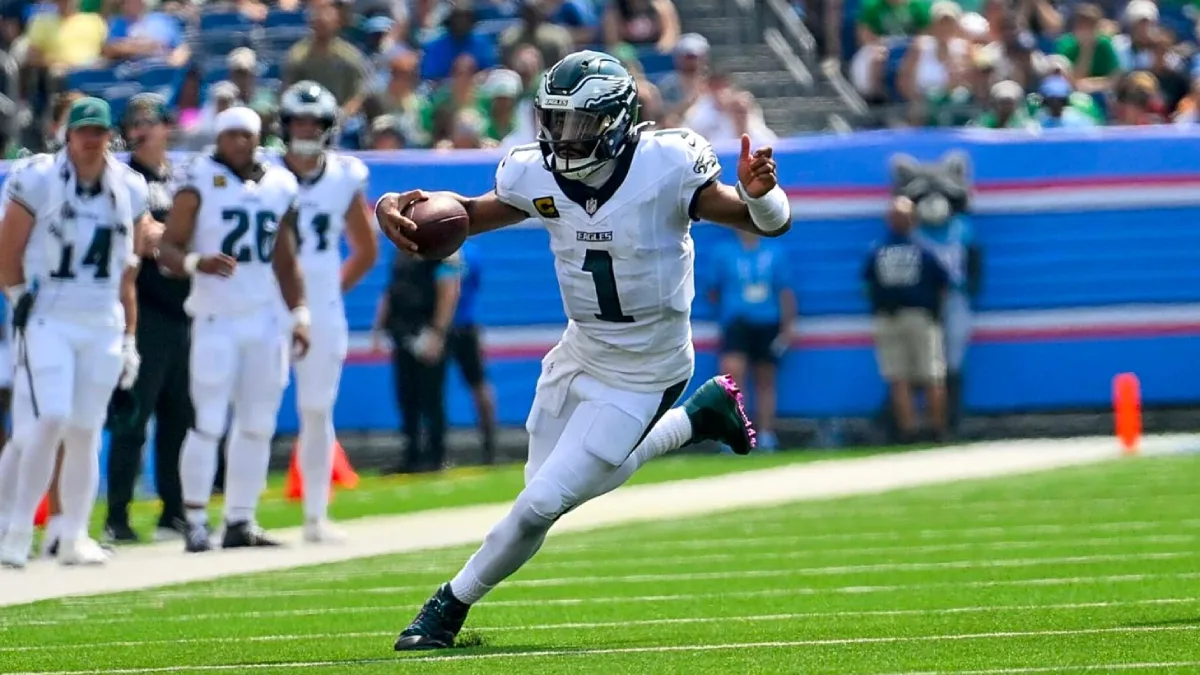
Start: Jalen Hurts, PHI (@ CHI)
Jalen Hurts is the preferred option thanks to his rushing upside and red-zone role.
Hurts provides fantasy owners with multiple paths to production, but his rushing ability is particularly valuable in difficult start/sit decisions. His goal-line opportunities give him touchdown equity that few quarterbacks can match.
Drake Maye faces a challenging road matchup against Jacksonville and an aggressive Jaguars pass rush. That creates additional pressure on a young quarterback in a difficult environment.
Bo Nix vs. Sam Darnold
Start: Bo Nix, DEN (vs. LAR)
Bo Nix gets the edge in a matchup that offers both volume and environment advantages.
Nix operates a high-volume passing offense at home and gets the Sunday Night Football stage in Denver. The combination of expected passing volume and home-field environment gives him a strong opportunity to produce.
Sam Darnold faces a road matchup against Washington where the game script could favor a more run-heavy approach. That limits his projected passing opportunities.
Running Back Start/Sit Decisions
Javonte Williams vs. Chuba Hubbard
Start: Javonte Williams, DAL (vs. BAL)
Javonte Williams is the preferred start because of his workload and the offensive environment surrounding him.
Williams operates as Dallas’ primary early-down and goal-line option, giving him valuable touchdown opportunities. The Cowboys also enter a matchup with one of the week’s highest projected totals, creating additional scoring potential.
Chuba Hubbard remains capable of producing, but he faces a difficult road matchup against Cleveland’s front seven. The Browns can bottleneck rushing lanes, making it more difficult for Hubbard to generate consistent yardage.
Kyren Williams vs. Omarion Hampton
Start: Kyren Williams, LAR (@ DEN)
Kyren Williams gets the nod because of his workload — even split with Blake Corum — in Sean McVay’s offense.
Williams continues to receive a fruitful share of the Rams’ backfield touches, making him a reliable option regardless of matchup. That workload provides both a strong floor and touchdown upside.
Omarion Hampton has significant talent, but his workload remains more difficult to project in a struggling Chargers offense. Playing on the road against Buffalo further complicates his Week 3 outlook.
Quinshon Judkins vs. TreVeyon Henderson
Start: Quinshon Judkins, CLE (vs. CAR)
Quinshon Judkins gets the edge because of the expected game script and Cleveland’s ability to lean on its running game.
Judkins faces Carolina at home in a matchup that sets up well for a run-heavy approach. If Cleveland controls the game, Judkins should have opportunities to accumulate carries and potentially find the end zone.
TreVeyon Henderson faces a more uncertain situation in New England’s backfield. A split workload combined with a road matchup against Jacksonville creates a lower projected floor.
Wide Receiver Start/Sit Decisions
Garrett Wilson vs. Parker Washington
Start: Garrett Wilson, NYJ (@ DET)
Garrett Wilson is the preferred start because of his role as the clear focal point of the Jets’ passing game.
Wilson’s target density makes him particularly attractive in a matchup at Ford Field, where the indoor environment can support explosive passing production. His volume gives him a strong floor while maintaining significant upside.
Parker Washington has shown the ability to command targets, but there are more mouths to feed. He also faces a disciplined New England defense that could limit passing efficiency.
Malik Nabers vs. Jaylen Waddle
Start: Malik Nabers, NYG (vs. TEN)
Malik Nabers gets the nod because of his dominant role in the Giants’ passing attack.
Nabers is the focal point of New York’s offense and has the opportunity to command a significant target share at home. That volume provides a strong foundation for fantasy production.
Jaylen Waddle remains one of the league’s most explosive receivers, but he operates in a Denver offense with multiple capable pass catchers competing for targets. That creates more uncertainty around his weekly volume.
Terry McLaurin vs. Denzel Boston
Start: Terry McLaurin, WAS (vs. SEA)
Terry McLaurin is the clear choice thanks to his role as Washington’s top wide receiver.
McLaurin commands a dominant share of the team’s passing opportunities, giving him a strong combination of volume and touchdown potential. Playing at home also provides an appealing environment for his Week 3 matchup.
Denzel Boston has intriguing upside, but his target volume is considerably less predictable. Cleveland also projects for a lower overall passing total, further limiting his expected opportunities.
Tight End Start/Sit Decisions
Dalton Schultz vs. Sam LaPorta
Start: Dalton Schultz, HOU (@ IND)
Dalton Schultz gets the Week 3 nod because of the massive target opportunity available to him in Houston.
With Nico Collins sidelined, Schultz has absorbed a significant portion of the Texans’ passing volume. He enters this matchup after catching 12 passes for 140 yards on 14 targets, giving fantasy owners plenty of evidence that his role has expanded.
Sam LaPorta still offers red-zone upside in Detroit, but Schultz currently has the more attractive target projection and volume floor.
Travis Kelce vs. Juwan Johnson
Start: Travis Kelce, KC (@ MIA)
Travis Kelce remains the preferred start because of his connection with Patrick Mahomes and importance in Kansas City’s red-zone offense.
Kelce continues to function as one of Mahomes’ most trusted targets, particularly when the Chiefs need a reliable option underneath or near the goal line. The fast-paced Miami matchup also creates opportunities for Kansas City’s passing game.
Juwan Johnson has the ability to contribute, but his target share remains more volatile within New Orleans’ passing rotation.
Isaiah Likely vs. Tyler Warren
Start: Isaiah Likely, NYG (vs. TEN)
Isaiah Likely gets the edge because of his combination of recent volume and matchup.
Likely has received 18 targets through two weeks, making him a significant part of the Giants’ passing attack. That type of volume is difficult to overlook at the tight end position, particularly when he gets a favorable home matchup.
Tyler Warren is also an important piece of Indianapolis’ offense, but he faces a tougher test against Houston’s defense. The matchup creates more uncertainty around his efficiency and fantasy production.
What to Consider When Making Week 3 Start/Sit Decisions
By Week 3, fantasy owners have enough information to begin identifying meaningful trends, but two games are still a small sample size.
When making difficult Week 3 start/sit decisions, consider these factors:
1. Target and Touch Volume: Opportunity remains one of the most important predictors of fantasy production. Players consistently receiving targets or touches deserve extra consideration.
2. Role Stability: Look for players whose offensive roles are clearly defined. A consistent snap share or goal-line role can be more valuable than a talented player with an uncertain workload.
3. Matchup: Consider how the opposing defense specifically matches up with the player’s position and strengths.
4. Game Environment: High projected team totals and competitive games can create additional opportunities for touchdowns and yardage.
5. Recent Usage: Two weeks of data can reveal changes in offensive roles, but fantasy owners should avoid treating every early-season trend as permanent.
Final Thoughts on Week 3 Start/Sit Decisions
The best approach to Week 3 start/sit decisions is to combine early-season usage with the matchup in front of each player.
Patrick Mahomes, Jalen Hurts, Javonte Williams, Kyren Williams, Garrett Wilson, and Malik Nabers all benefit from a combination of strong roles and favorable fantasy environments. Meanwhile, players such as Jared Goff, Omarion Hampton, Jaylen Waddle, and Tyler Warren face circumstances that introduce additional uncertainty.
Two weeks of NFL data can help fantasy owners identify changing roles, but it should be used as evidence rather than treated as a definitive verdict on a player’s season. Focus on volume, role, matchup, and scoring opportunity when setting your Week 3 lineup.